
Writing to Heal
Developing an expressive writing app to support caregivers of spouses living with Alzheimer’s or a related dementia
Client: The North Florida HEAL Lab

Writing to Heal
Developing an expressive writing app to support caregivers of spouses living with Alzheimer’s or a related dementia
Client: The North Florida HEAL Lab
Services
Product Design, UX Research, UX Content Writing, Branding, Strategic Planning, Website & App Development, Manuscript Support & Coauthoring, Promotion and Outreach
Timeframe
February 2024 – Present
Uniting clinical research and UX design
In 2022, researchers at The HEAL Lab began developing a writing intervention aimed at reducing stress and improving quality of life for caregivers whose spouses are living with Alzheimer’s or a related dementia (ADRD). The internet-based study required a digital platform where caregivers could complete a guided expressive writing series.
In February 2024, we teamed up with the research team to design a user-friendly digital product that supported their vision while addressing the unique needs of this caregiver population.
Our Challenge
Create a supportive, secure, digital environment to gently guide caregivers as they explore their caregiving experiences through a series of targeted writing prompts.
The Solution
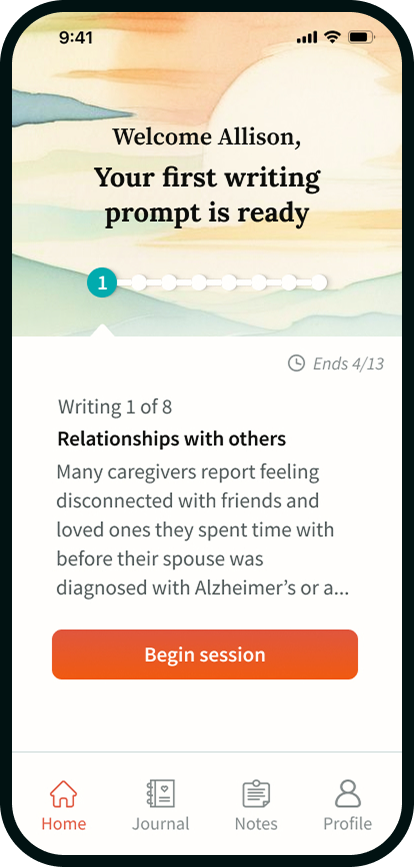
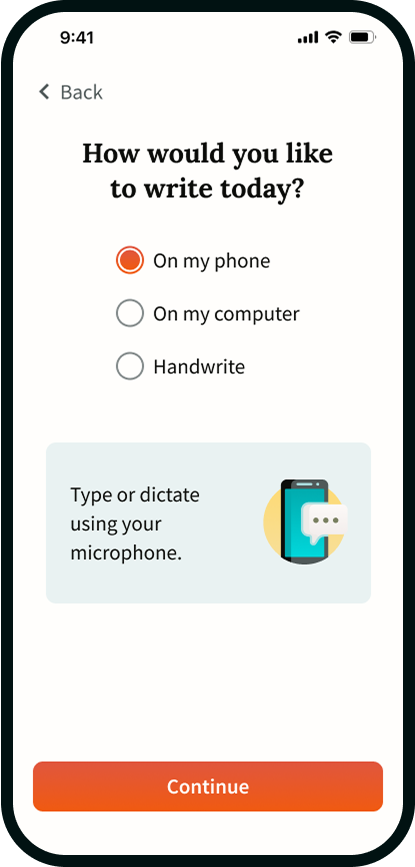
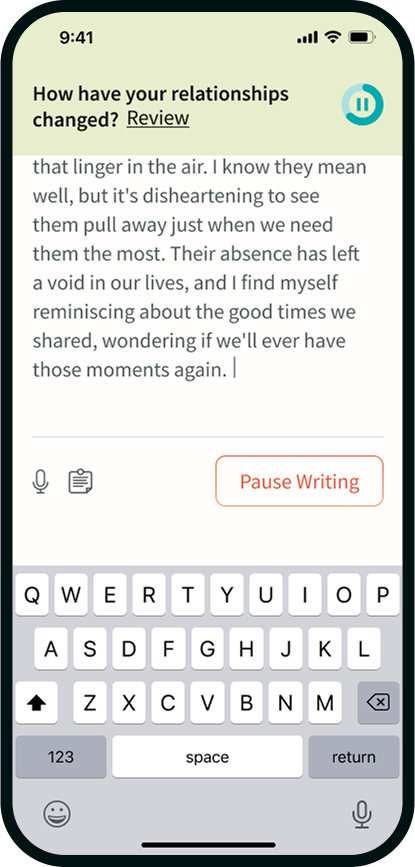
We designed an app and supporting website using a soothing, minimalist approach, prioritizing simplicity and ease of use. Writing options are adaptable to accommodate diverse preferences, while researchers are equipped with tools for enrollment, engagement tracking, and data collection.
“Collaboration with an industry-based product designer was essential for the success of this intervention development project.”
Angie S. LeRoy, PhD
Principal Investigator, The North Florida HEAL Lab
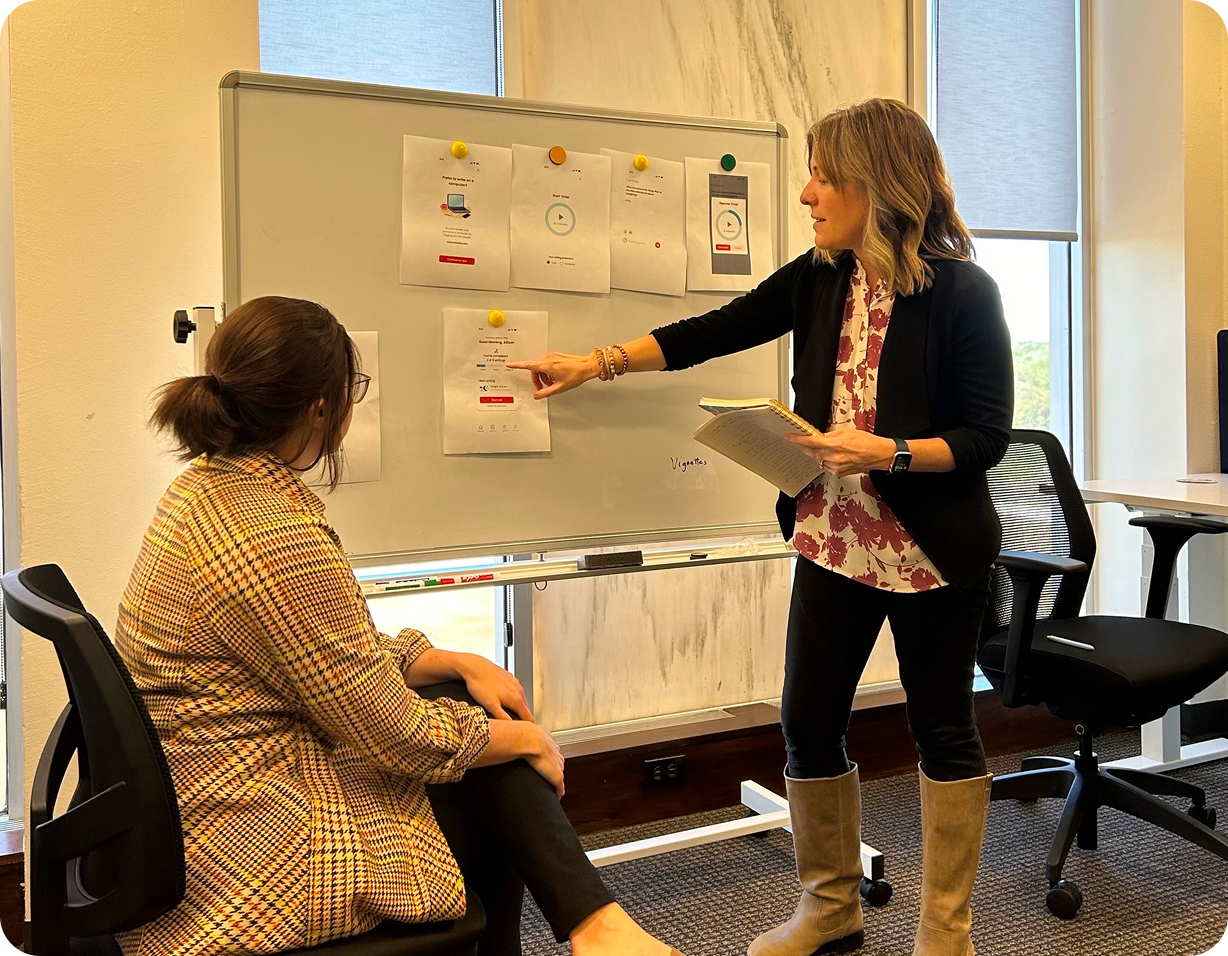
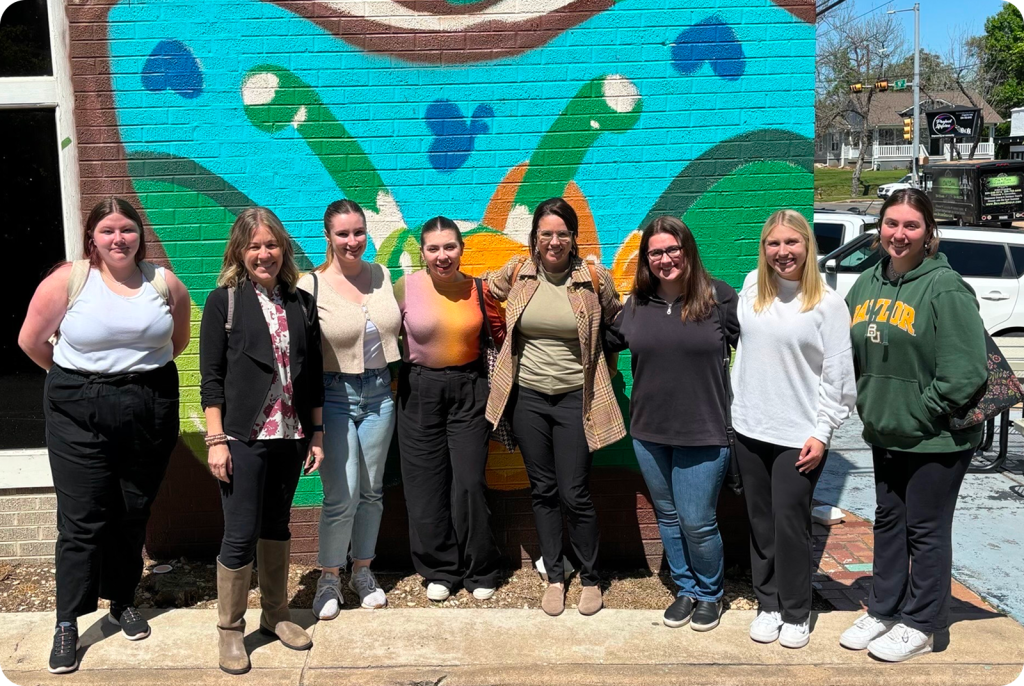
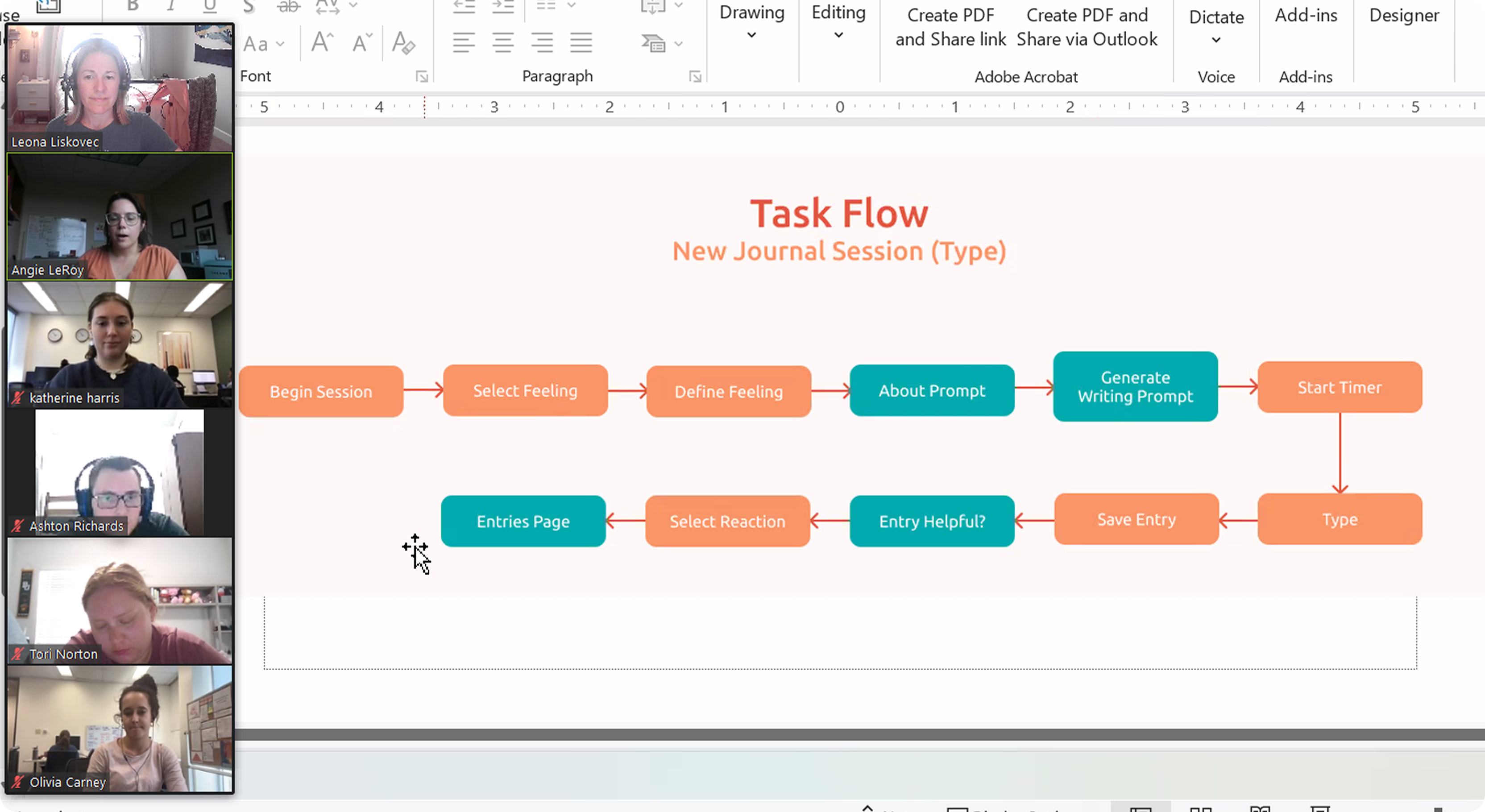
Regular check-ins and close collaboration with the HEAL Lab were key to making quick decisions and meeting tight deadlines throughout the rapid design and testing process.
Recruiting for discovery
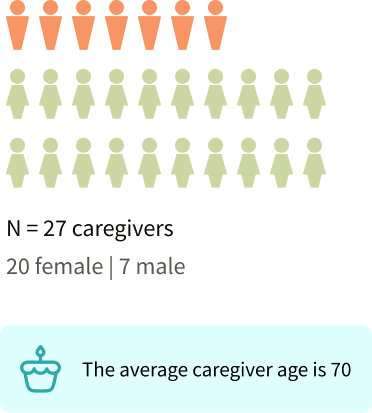
Through a rigorous recruitment process, the HEAL Lab enrolled 27 spousal caregivers from across the country. Participants engaged in up to eight focus groups and one-on-one usability tests. The app was designed in parallel with these sessions, with user feedback guiding each step.
All participants were over 60 and actively caring for a spouse living with ADRD. While mindful of potential biases, we also leveraged existing knowledge about this demographic, such as the need for larger text sizes, to inform thoughtful design decisions.
Mapping everyday realities for caregivers
4 remote focus groups (n=5, n=6, n=6, n=4)
Because caregivers already face so many challenges, the HEAL Lab’s first aim was to understand whether an internet-based expressive writing study was both feasible and acceptable for them. Researchers asked questions like, “What are your initial thoughts about writing?” “When could you find time to write?” and “How are you most comfortable writing?”
Using affinity mapping, several valuable insights surfaced that we used to guide early product ideation.
Insights
Opportunities
Caregivers are open to writing if it will improve well-being
Find ways to show progress and benefits
Caregivers are exhausted and busy
Must be easy to start writing. Can’t feel like another chore.
Half of caregivers are apprehensive about expressive writing
Must feel soothing. Consider objective writing options.
Half of caregivers prefer writing by hand to digital entry
Explore ways to upload handwritten samples
Best time to write is when spouse is preoccupied
Writing schedule must be flexible
Caregivers are concerned about privacy
Consider screen locking and other security features
Keeping caregiver needs at the forefront
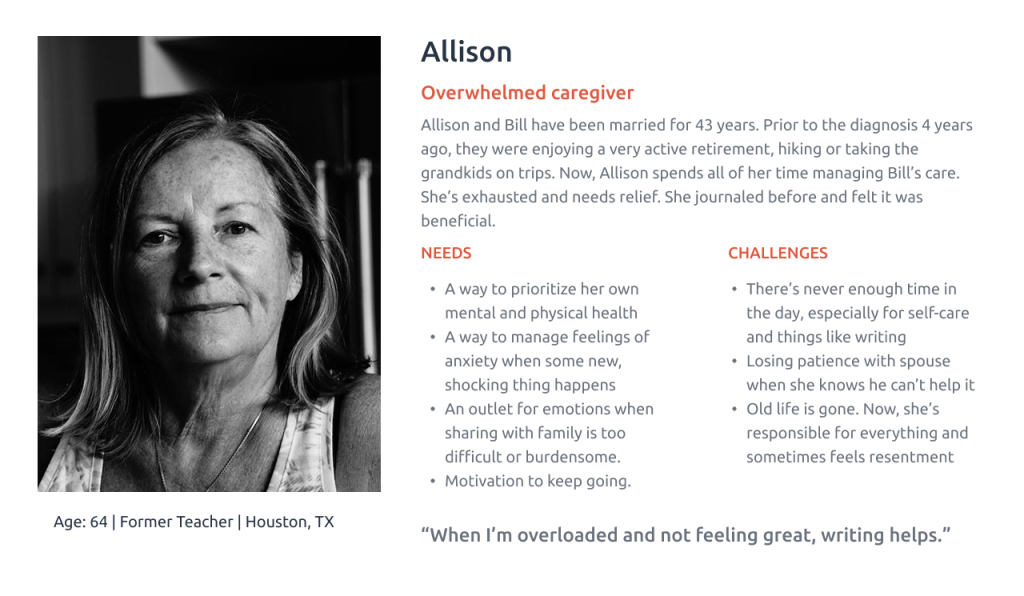
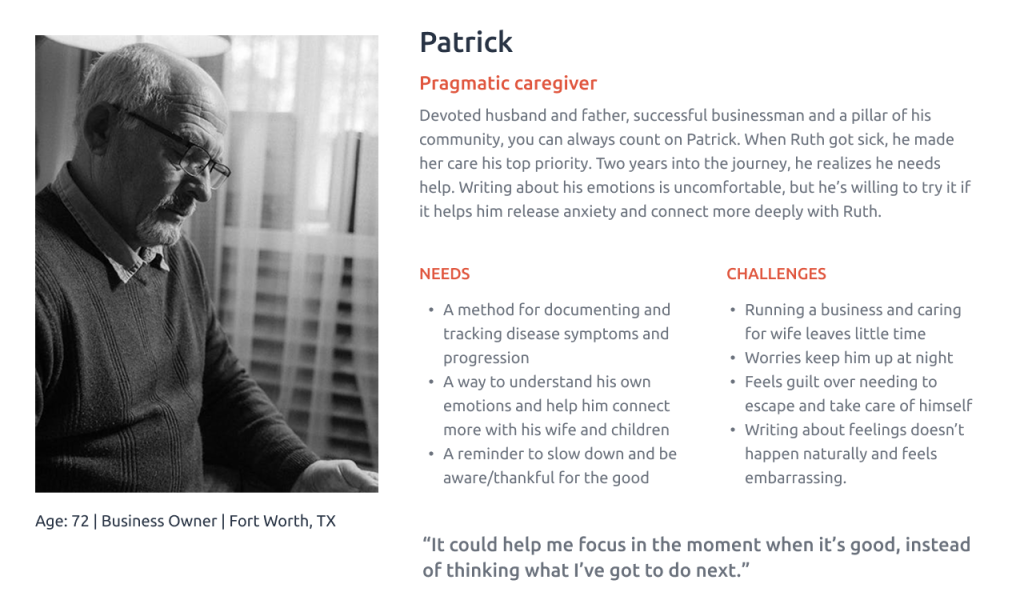
From our research, we created two personas—Allison and Patrick—each reflecting different attitudes, motivations, and challenges caregivers might face around expressive writing. These mental models helped us stay grounded in real user needs as we made decisions about features, content, navigation, and overall flow.
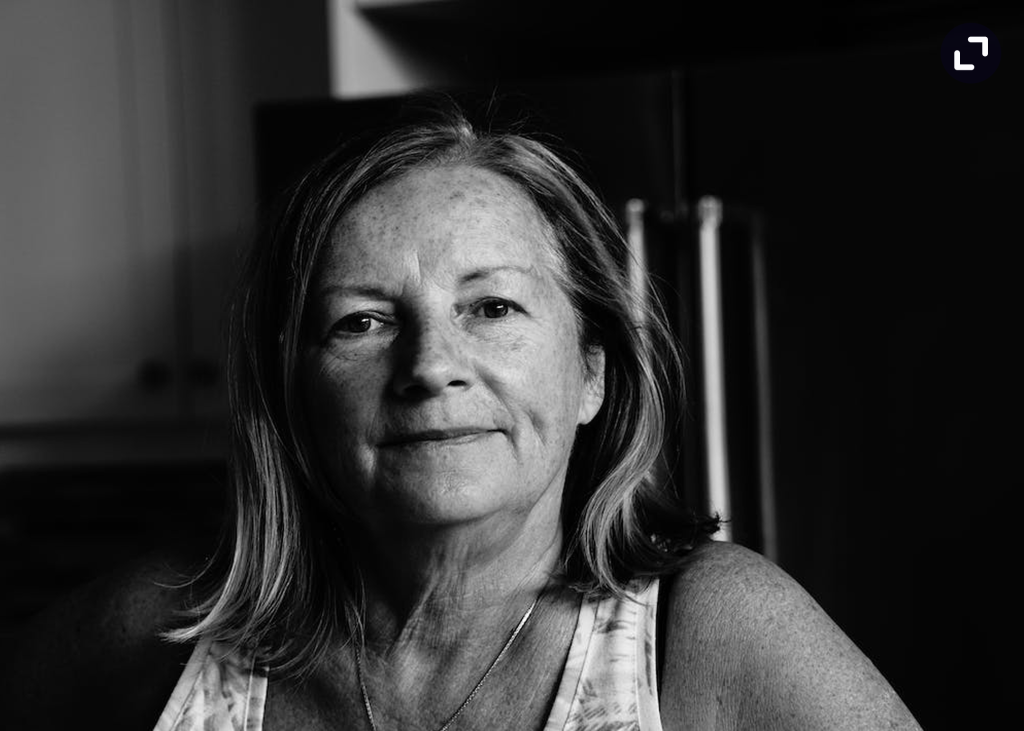
Overwhelmed Allison
“When I’m overloaded and not feeling great, writing helps.”
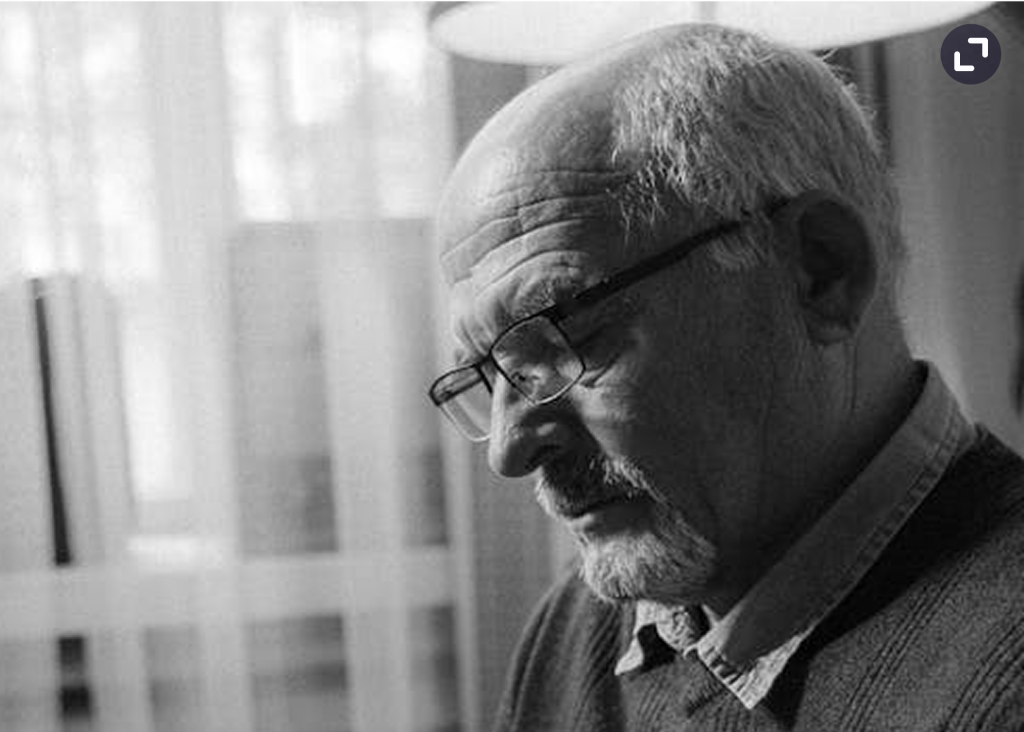
Pragmatic Patrick
“Writing could help me focus on the good, instead of thinking what I’ve got to do next.”
Think, design, test, repeat
4 remote focus groups (n=5, n=4, n=5, n=2)
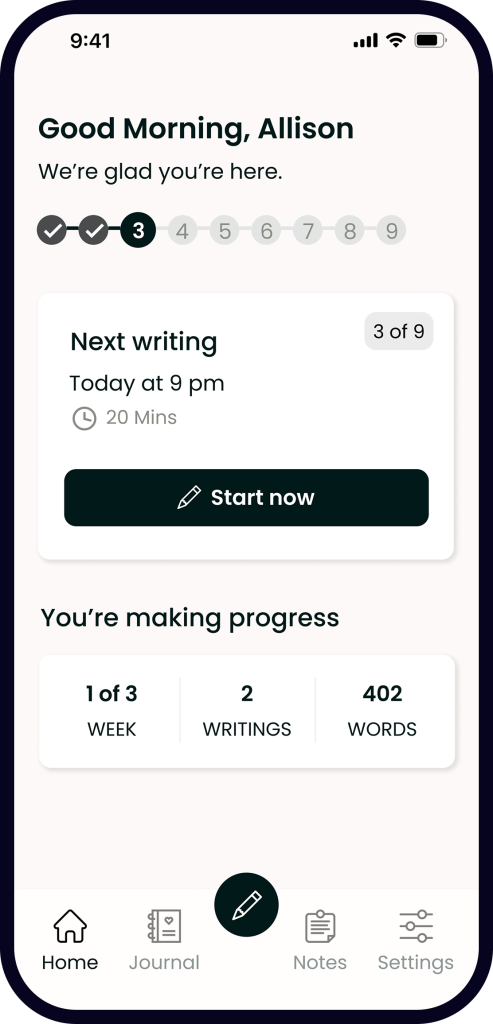
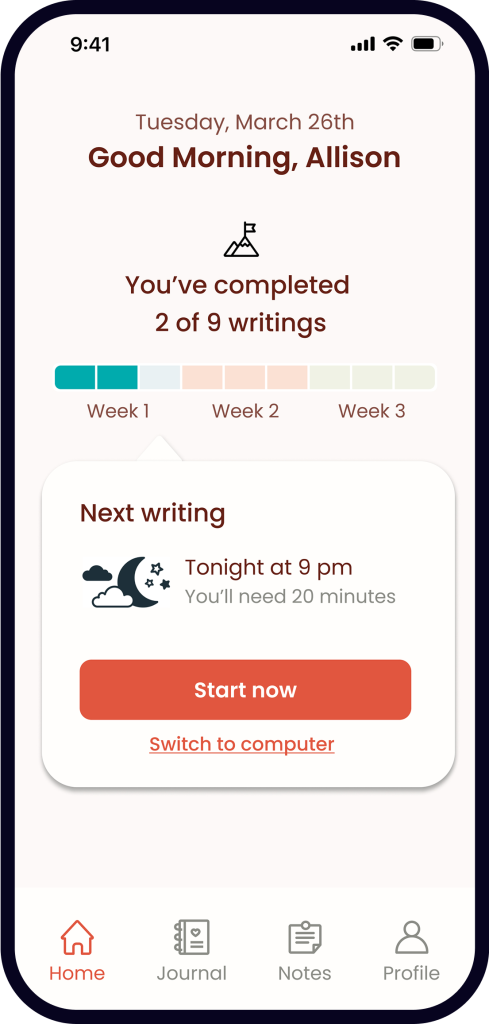
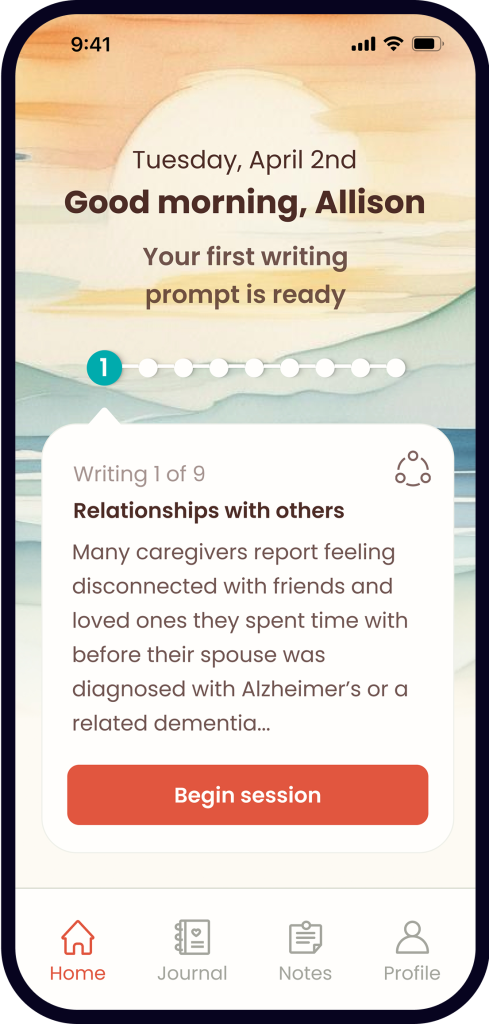
In this wave of research, we introduced mid- and high-fidelity wireframes to caregivers. By scheduling sessions one week apart, we were able to refine the designs based on real-time feedback and test iterations with each new group. This rolling approach allowed us to adapt quickly while staying closely aligned with caregiver perspectives.
Home screen iterations
Group 1
- Too many numbers for exhausted caregivers
- Not easy to start
- Feels transactional
Group 2
- Greeting is welcoming
- Cluttered. Needs focus
- Confusing progress bar
- Mountain climb icon feels tiring, not good fit
Group 3
- Calming colors and images
- Focused on writing
- Preview of writing prompt is engaging
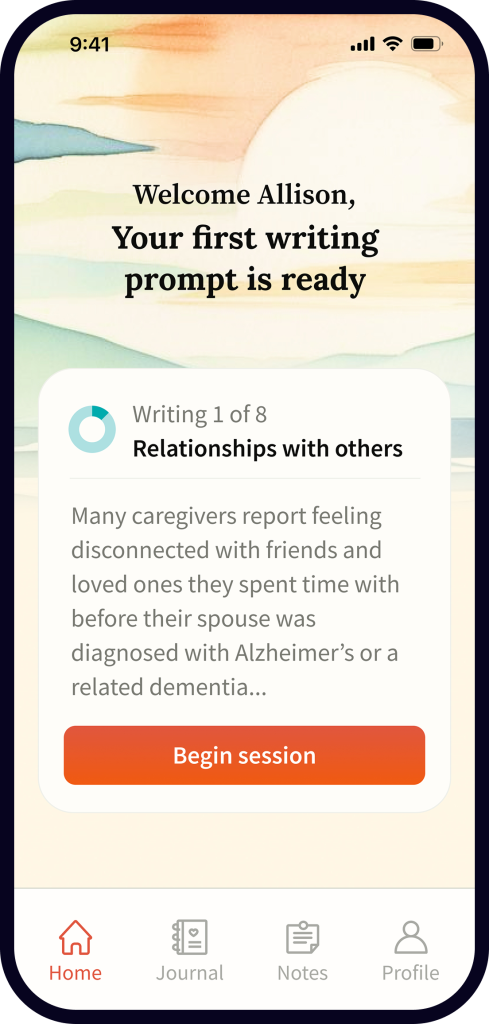
Group 4
- Feels welcoming
- Prefer progress bar to circle
- Needs color contrast
- Add prompt end date
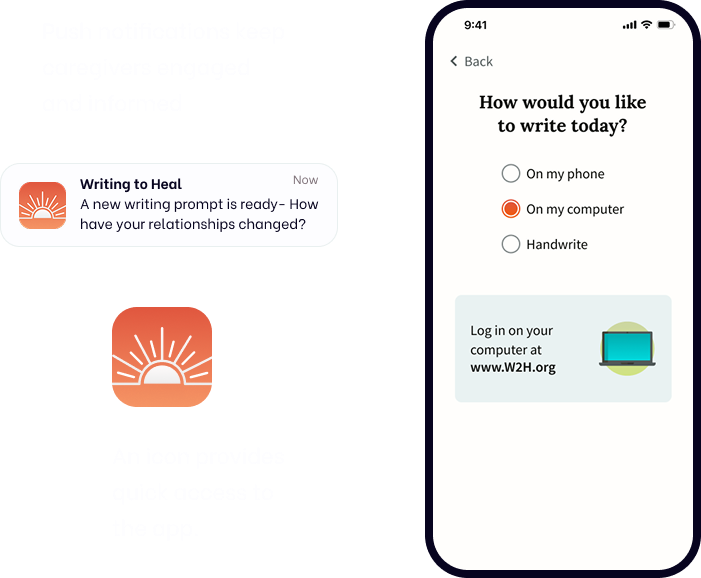
Do we need an app or a website?
We kept coming back to this important question. Half of the caregivers preferred to write digitally, ideally on a computer. At the same time, they’re often on the go and rely on their phones to stay organized and connected.
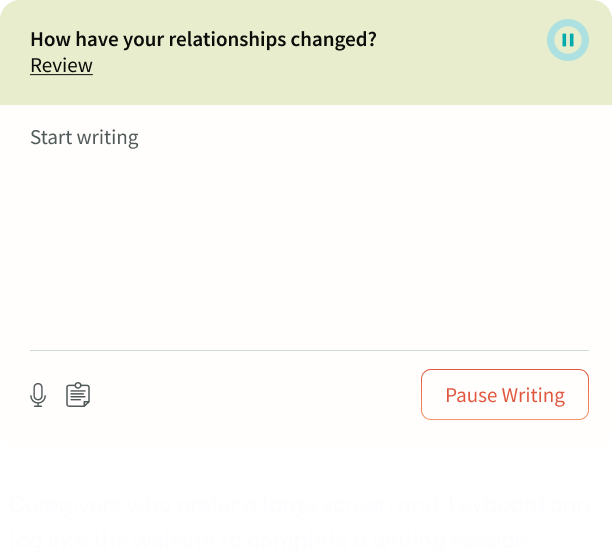
Ultimately, we decided the writing experience worked best as a mobile app, supported by a simplified website that syncs writing entries across devices.
Branding for calm
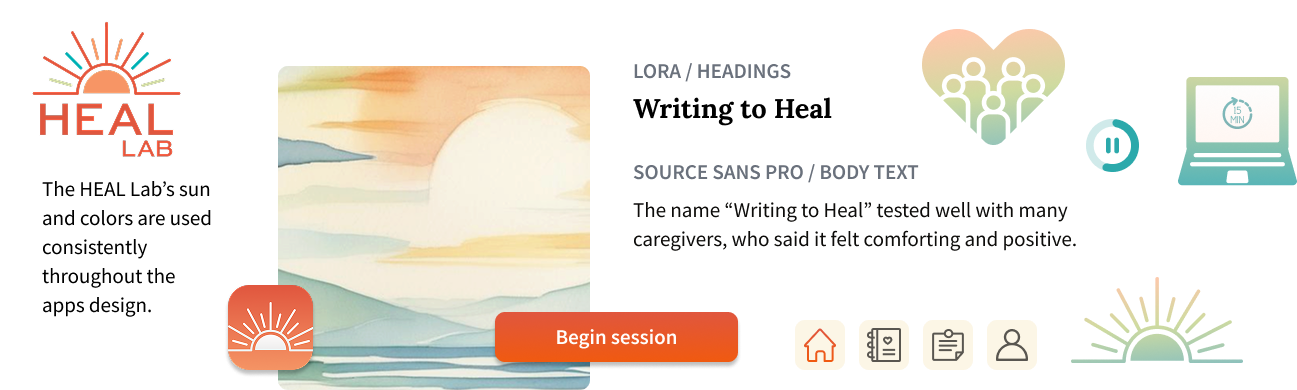
We began with the HEAL Lab’s existing palette, which offered a strong foundation. The vibrant orange became our primary action color, chosen for its warmth, visibility, and ability to gently draw attention to buttons and other key elements.
For the rest of the interface, we leaned into soft, muted tones of blue and green. The overall goal was to create a space that feels more like a warm blanket than a clinical tool, where users could explore emotional topics with a sense of calm and comfort.
Testing the prototype for usability
To evaluate our design’s usability, we transitioned from focus groups to individual user testing. After receiving approval from the Institutional Review Board (IRB), we observed five caregivers complete three tasks using our prototype. By watching them interact with the app, we could see what worked well and where users got stuck or needed more information.

It’s easy to complete a writing session
All caregivers completed the task flow “Writing from a prompt” with no blockers in about 6 minutes.
Pausing and saving a draft is helpful
Caregivers suggested we tell them about this feature before they begin writing.
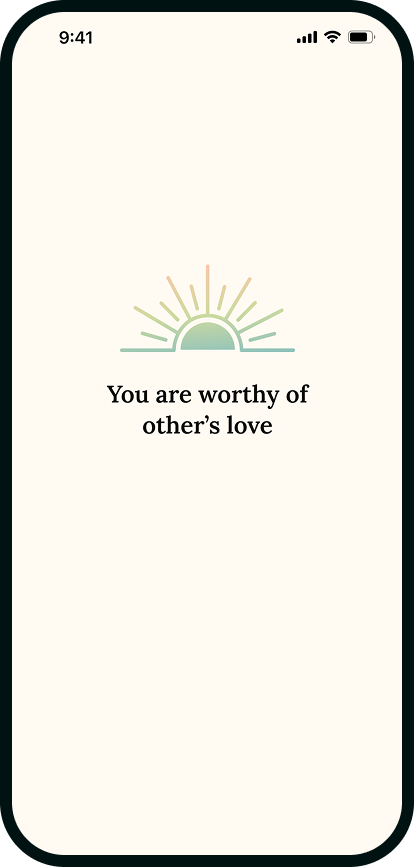
Affirmations are well-timed
Caregivers like this reminder to be kind to themselves.
The microphone icon is highly visible and valuable
All caregivers saw it and some said they would use it to dictate their writing sessions.

Finding Notes is difficult
3 of 5 caregivers needed assistance to find Notes in the main menu.
The concept of making a note is confusing
Caregivers didn’t seem to understand why and how they would use notes. While 3 of 4 completed the task flow “Write from a note” without help, there was a lot of hesitation and uncertainty.
Experience the prototype
What’s next
Pilot testing begins 2026
The Writing to Heal app and website are currently in development. In spring 2026, the HEAL Lab will launch its first trial using a beta version of the product. Ongoing evaluation will help refine the experience and assess the value and usability of each feature.
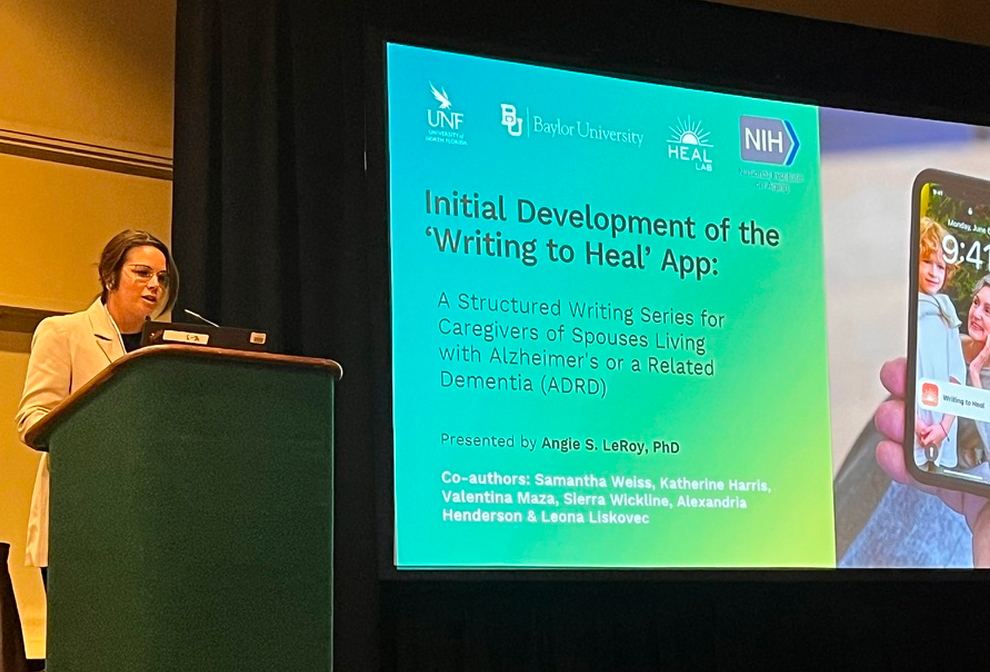
In addition to product development, the team has published a research article—“Initial Development of the Writing to Heal App: A Structured Writing Series for Caregivers of Spouses Living with ADRD”—in the Journal of Alzheimer’s Disease. We were proud to contribute to the manuscript, with Leona listed as a coauthor.
As the study moves forward, we’ll also be supporting broader visibility through outreach and education. From presenting the work at national conferences like the Gerontological Society of America to sharing it with students and faculty on the UNF campus, we’re excited to help bring this important research into the world.
Want to learn more?
Visit the North Florida HEAL Lab website to get involved or stay informed about upcoming research.
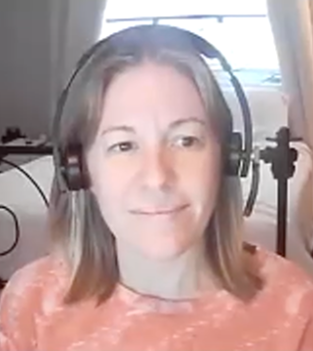
Leona completed the CITI Program training in Social & Behavioral Research, a requirement of the IRB to ensure interviews and testing are done ethically and with care.
Reflecting on the process
This project was a natural fit for our team, rooted in health psychology, a field we find deeply meaningful. It was also the ultimate test of empathy. The caregivers we interviewed and tested were going through the heartbreak and exhaustion of supporting a spouse living with ADRD. When scripting usability sessions, we had to place participants in realistic caregiving scenarios, like running late because their partner couldn’t get dressed that morning. What’s normally a neutral part of testing became something much more delicate. We had to stay true to their experiences without triggering painful emotions. That balance was hard but important, and it taught us how to approach human-centered design with deeper care and respect.
Another challenge was navigating the tension between user needs and research constraints. Unlike most projects, we couldn’t simply cut features for time or budget; we had to strip them away for scientific accuracy. Even simple additions, like letting caregivers choose between writing prompts, would introduce too many variables for a controlled study. That meant no AI, no layered options, and little personalization. While frustrating at times, it gave us valuable experience designing an ultra-lean MVP with a sharp focus on clarity and outcomes. That discipline is something we’ll carry forward into future work.